
1.栈
1.1.栈概念
1.2.栈接口
1.3.栈细节
1.4.栈实现
2.队列
2.1.队列概念
2.2.队列接口
2.3.队列细节
2.4.队列实现
3.串
3.1.串概念
3.2.串接口
3.3.串细节
串最重要的接口莫过于在主串中定位子串的位置,这种定位运算就是串的模式匹配(串匹配),这里简单介绍两种实现。
3.3.1.BF 算法
暴力匹配的算法。
//BF 算法
#define _CRT_SECURE_NO_WARNINGS 1
#include <stdio.h>
#include <string.h>
#include <stdbool.h>
#include <assert.h>

bool IsEqual(const char* s, const char* subS)
{
	//避免一开始就传过来空的模式串
	assert(*subS != '\0');

	//一一比较每一个字符
	while ((*subS != '\0') && (*s == *subS))
	{
		s++;
		subS++;

		//处理模式字符长度大于主串子串的情况
		if ((*subS != '\0') && (*s == '\0'))
			return false;
	}

	//相等说明匹配完
	return *subS == '\0';
}

int BF(const char* mainS, const char* subS)
{
	int mainSSize = strlen(mainS);
	int subSSize = strlen(subS);
	int size = mainSSize - subSSize + 1;
	for (int i = 0; i < size; i++)
	{
		if (IsEqual(mainS + i, subS))
		{
			return i;
		}
	}
	return -1;
}

int main()
{
	const char* mainS= "aaabcd"; //主串
	const char* subS = "abcd"; //模式串
	int index = BF(mainS, subS); //暴力匹配
	printf("%d\n", index); //得出主串中对于的索引值
	return 0;
}
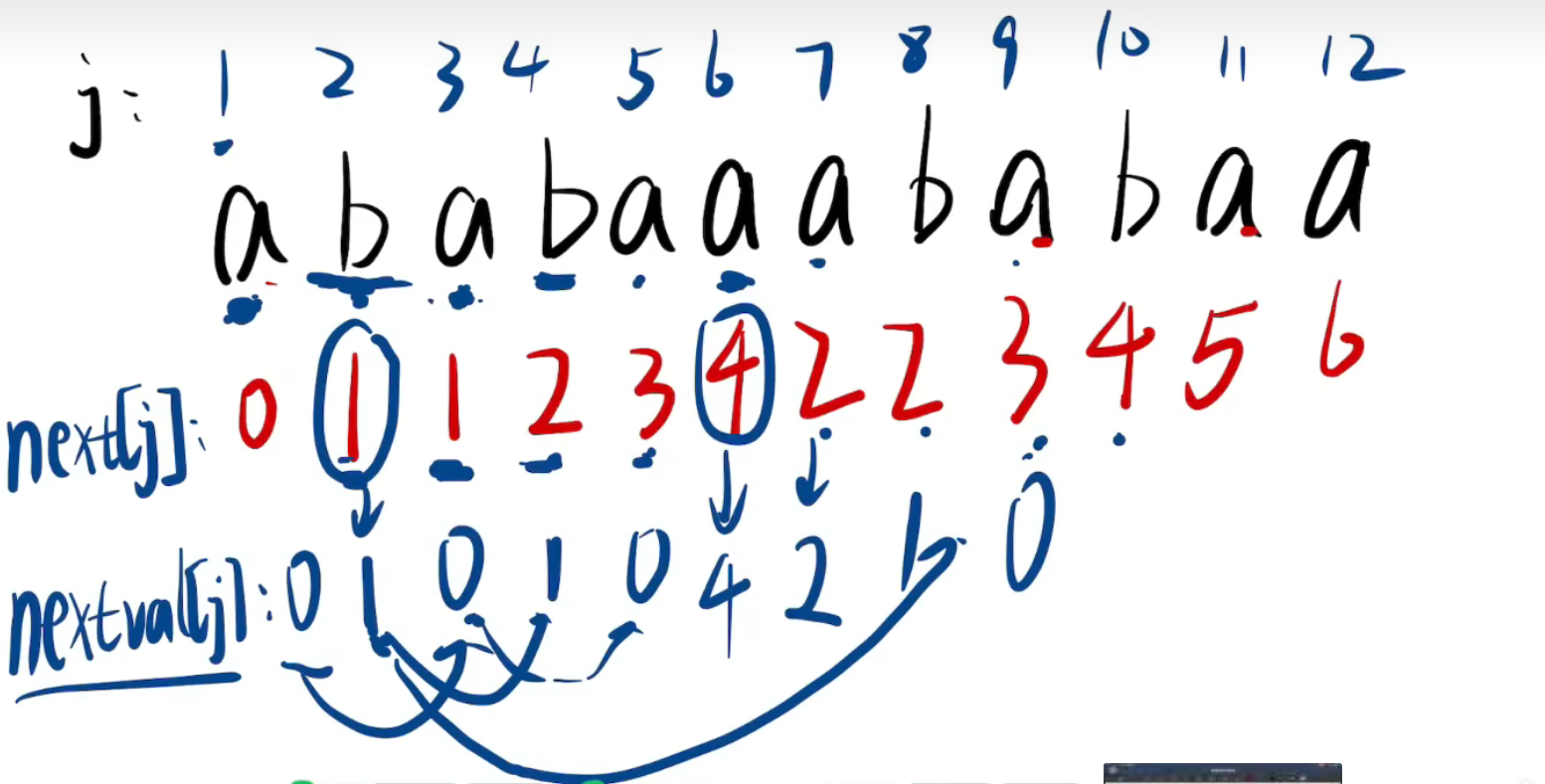
3.3.2.KMP 算法
| a | b | a | b | a | a | a | b | a | b | a | a | |
|---|---|---|---|---|---|---|---|---|---|---|---|---|
| 0 | 0 | 1 | 2 | 3 | 1 | 1 | 2 | 3 | 4 | 5 | 6 | |
| -1 | 0 | 0 | 1 | 2 | 3 | 1 | 1 | 2 | 3 | 4 | 5 | |
| 0 | 1 | 1 | 2 | 3 | 4 | 2 | 2 | 3 | 4 | 5 | 6 | |
| null | a | a | b | a | b | b | b | a | b | a | a | |
| 0 | 1 | 0 | 1 | 0 | 4 | 2 | 1 | 0 | 1 | 0 | 4 |
3.4.串实现
4.实践
4.1.栈
4.1.1.逆波兰表达式
4.1.2.双栈
4.1.3.递归与非递归转化
Ack(m, n) = \left\{ \begin{array}{left} n + 1, m = 0\\ Ack(m-1, 1), m \neq 0 \text{且} n = 0 \\ Ack(m - 1, Ack(m, n - 1)), m \neq 0 \text{且} n \neq 0\\ \end{array} \right.
用递归和非递归的方式写出上述函数的对应算法。